The Dollar’s Slow Bleed
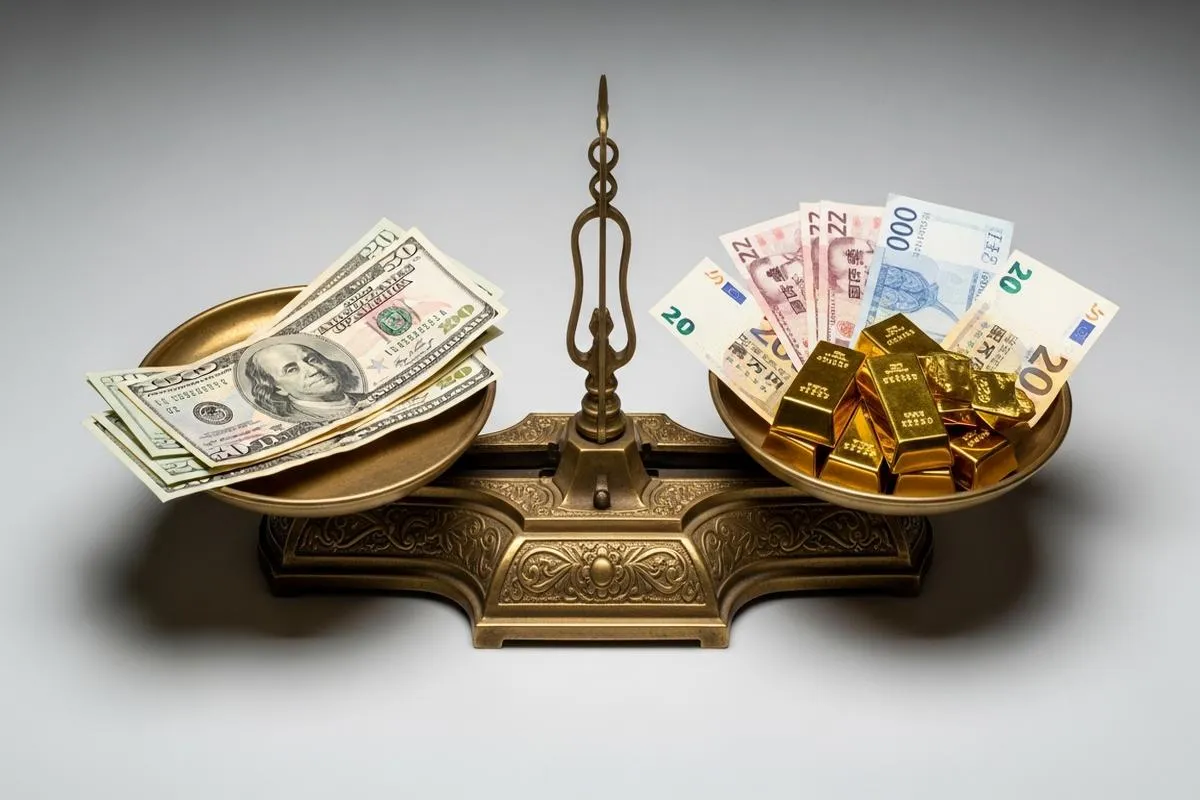
The headline is designed for panic: the US dollar’s share of global foreign exchange reserves has fallen to its lowest level in three decades. The immediate narrative is one of collapse, of a dethroning. This is a simplistic and ultimately incorrect interpretation of the facts.
The dollar is not being dumped. It is being diluted.
Foreign central banks are not engaged in a fire sale of their US Treasury holdings. Look at the absolute numbers. Their holdings of USD-denominated assets have remained remarkably flat for the better part of a decade. What has changed is the denominator. Total global reserves have ballooned, and the new capital is flowing elsewhere. This isn’t a vote of no-confidence; it’s a vote for portfolio diversification. It’s a slow, rational rebalancing away from concentrated risk.
The Mechanics of Dilution
To understand this shift, one must ignore the political theater and focus on the balance sheet. A central bank’s reserve portfolio is not a political statement; it’s a liquidity and stability tool. For decades, the US dollar was the only viable option for deep, liquid, and ostensibly safe assets. This created a structural overweight in every sovereign portfolio on the planet.
That reality is changing. The core driver is not a sudden desire to punish Washington, but the unavoidable reality of America’s “twin deficits.” A nation that simultaneously runs massive trade and federal budget deficits is, by definition, exporting its debt to the rest of the world. Foreign central banks have been the primary absorbers of this debt, a process that underwrites the dollar’s status and grants the US its “exorbitant privilege”—the ability to consume beyond its means, funded by others.
This arrangement is not permanently sustainable. The buyers of this debt—foreign governments—are now behaving like any prudent asset manager. They are hedging. They are not selling their core US position, but they are allocating new capital to other assets to reduce their dependency on a single issuer’s fiscal discipline, or lack thereof.
The Rise of the ‘Other’
The most telling data point is not the decline in the dollar’s share, but the destination of the new money. It is not flowing into a single challenger like the Euro or the Chinese Renminbi. The Euro’s share has been stagnant for years, hampered by the Eurozone’s own structural fragilities. The Renminbi remains a bit player, its potential capped by Beijing’s capital controls and lack of true convertibility. A currency you cannot freely move is not a reserve currency; it is a tool of state control.
Instead, capital is fragmenting. It is flowing into a basket of what the IMF calls “non-traditional reserve currencies.” Think Canadian and Australian dollars, among dozens of others. Individually, they are insignificant. Collectively, their share has more than doubled in recent years and now surpasses that of the Japanese Yen.
This is not a search for a new king. It is the end of monarchy. Central banks are building a diversified portfolio of smaller, less-correlated currency assets. The goal is to reduce volatility and hedge against the policy errors of any single major economic bloc, including the United States. It’s a pragmatic, logical, and deeply boring strategy—which is precisely why it’s so significant.
Gold: The Ultimate Counterparty Hedge
Parallel to this currency diversification is the renewed interest in gold. Gold is not a currency; it generates no yield and serves no role in modern transactions. Its value is as a hedge against the system itself. When central banks buy gold, they are buying an asset with zero counterparty risk.
A US Treasury bond is a claim on the US government’s ability and willingness to pay. A Euro-denominated bond is a claim on the ECB. Gold is a claim on no one. It is a sterile asset, an insurance policy against the fallibility of all fiat regimes.
After decades of selling off their holdings, central banks reversed course during the 2008 financial crisis. They have been steady buyers ever since. This is not a nostalgic return to the gold standard. It is a clear-eyed acknowledgment that in a world of unprecedented debt and fiscal experimentation, holding a physical asset outside the control of any single sovereign is simply good risk management.
The Inevitable Repricing
What does this mean for the United States? The slow erosion of the dollar’s reserve share will not trigger a sudden crisis. There will be no single event, no dramatic headline. Instead, the consequences will be gradual and structural.
The cost of funding the twin deficits will slowly rise. The deep, captive pool of buyers for US debt is becoming less captive. As demand diversifies, the price of that debt—the interest rate—will have to adjust upwards to attract buyers. This constrains fiscal policy, making it more expensive for the government to run deficits.
It also curtails geopolitical leverage. The dollar’s dominance is a pillar of American foreign policy. As its unique status fades, so too will the effectiveness of financial sanctions and other economic tools.
The dollar’s story is not one of a dramatic fall from grace. It is the story of an anomaly coming to a slow and logical end. The world is too large and economically diverse to have its financial system predicated on the currency and credit of a single nation. The rebalancing we are witnessing is not an attack, but an inevitability.