Inaction Is the Most Expensive Strategy
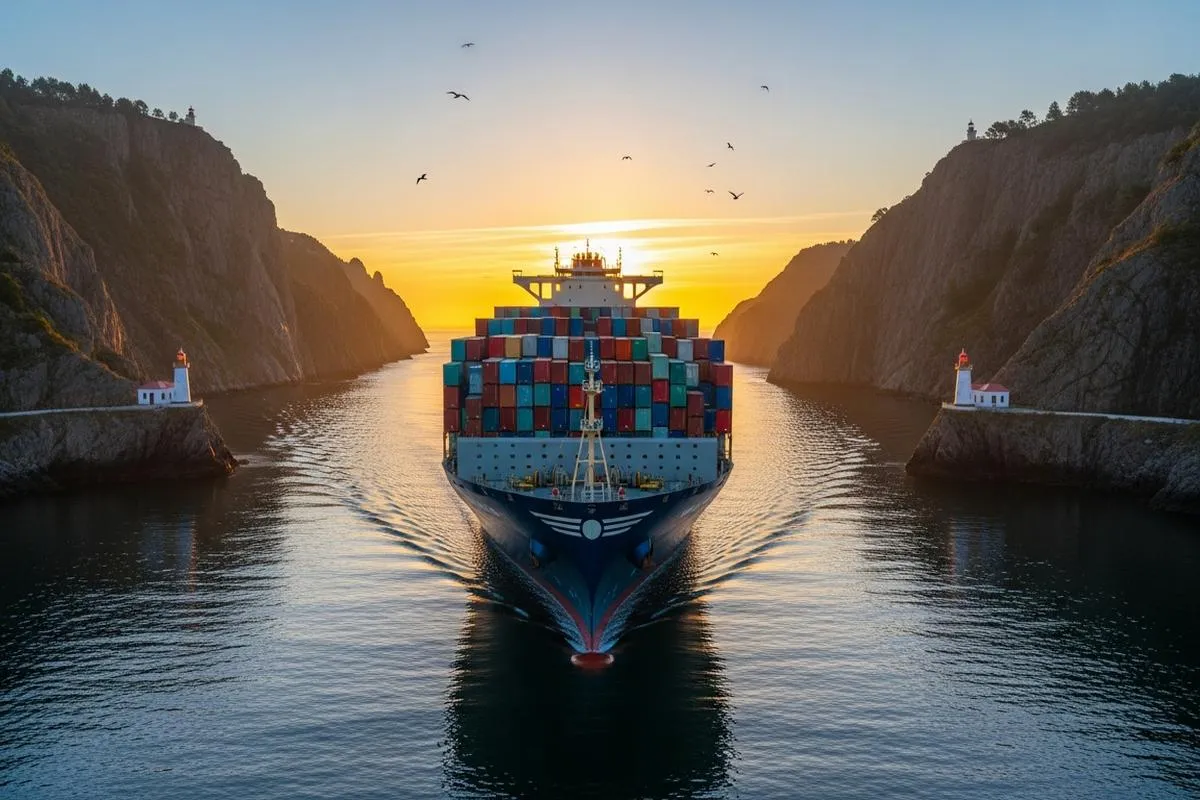
The planet is 25,000 miles in circumference. The global economy runs on about 100 of them.
This isn’t a metaphor. It is a statement of account. The entire operating system of modern commerce, from raw material extraction to final assembly and delivery, is entirely dependent on a handful of narrow maritime passages. These are not just shipping lanes; they are non-negotiable single points of failure in a system with zero redundancy. The Strait of Hormuz, the Strait of Malacca, the Suez Canal, the Bab el-Mandeb, and, most critically, the Taiwan Strait.
Close one, and you introduce a liquidity crisis into the physical world. Close the wrong one, and you trigger a complete system failure.
Iran’s closure of the Strait of Hormuz, therefore, should not be viewed through the lens of regional Middle Eastern politics. That is a tactical error, a failure to see the strategic landscape. This is a practice test. It is a live-fire drill designed to measure the response time, political will, and operational capability of the system’s underwriter: the United States. The real audience for this test is not in Tehran, but in Beijing. How America handles this manageable crisis in the Persian Gulf will directly inform China’s cost-benefit analysis for initiating an unmanageable one in the Western Pacific.
The Anatomy of a Chokepoint
To understand the stakes, we must first abandon romantic notions of global trade and see it for what it is: a brutally efficient, hyper-optimized, just-in-time manufacturing line that spans the globe. This system was designed for maximum efficiency, not maximum resilience. The chokepoints are its most critical conveyor belts.
Hormuz is the energy input. Roughly 20% of the world’s total oil consumption and a third of its liquefied natural gas pass through a channel only 21 miles wide at its narrowest point. A closure here doesn’t just mean higher prices at the pump. It means a sudden, catastrophic price shock for every downstream product: plastics, fertilizers, pharmaceuticals, and the transportation costs embedded in every single physical good. It is a tax on everything, everywhere, effective immediately.
The Taiwan Strait is the logic board. Over half of the world’s container fleet by tonnage sails through this 110-mile-wide strait annually. But its true significance lies in what its neighbor produces. Taiwan manufactures over 60% of the world’s semiconductors and over 90% of the most advanced nodes—the chips that power everything from iPhones and data centers to advanced weaponry. A blockade of Taiwan and the effective closure of its strait doesn’t just disrupt the flow of finished goods. It halts the production of nearly every advanced electronic device on Earth. It is a hard stop on the digital economy.
A crisis in Hormuz is a severe but potentially manageable economic heart attack. A crisis over Taiwan is a medically induced coma with no certain prognosis for recovery. Iran is offering a controlled experiment in the former. China is watching to see if the patient has the will to survive, before it attempts to induce the latter.
Deterrence Is an Insurance Policy
The post-World War II global order, often mischaracterized as a project of idealism, is at its core a business arrangement. The United States, through its naval supremacy, underwrites an insurance policy for freedom of navigation on the high seas. The premium for this policy is the US defense budget. The guaranteed payout is the stable, predictable, and secure transit of goods that enables the global economy. This stability is the most valuable public good in modern history, and the US benefits disproportionately from the system it secures, most notably through the primacy of the U.S. dollar.
Iran’s move to close the Strait of Hormuz is, in this framework, a claim filed against the policy. It is a test of the underwriter’s credibility. Is the policy still in force? Will the insurer pay out?
A weak, delayed, or brokered response—one that relies on diplomacy, sanctions, or outsourced security to regional partners—is equivalent to the insurer denying the claim. It signals to all other policyholders that the contract is worthless. The perceived risk of disrupting maritime trade plummets, because the guarantor has demonstrated an unwillingness to enforce the terms.
This is precisely the signal Beijing is waiting for. A Chinese blockade of Taiwan is currently held in check by a single variable: the perceived certainty and effectiveness of an American military response. If the U.S. proves unwilling or unable to decisively reopen a critical waterway against a second-tier power like Iran, the probability of it intervening against a peer competitor like China drops precipitously in Beijing’s calculus. Deterrence is not a function of capability alone; it is a function of perceived will. A failure in Hormuz is a catastrophic failure of signaling. It is an open invitation for a strategic miscalculation in the Taiwan Strait.
The Cold Calculus of Action vs. Inaction
The debate over intervention is often framed in false terms of war versus peace. The correct framework is risk management. We must analyze the profit and loss statement of both courses of action.
The Cost of Decisive Action in Hormuz:
- Direct Costs: The expenditure on fuel, munitions, and deployment of assets (escorts, minesweepers, air power for strikes on launch sites). These are quantifiable, significant, but ultimately manageable budget items.
- Risk: The potential for military escalation with Iran. This risk is real but can be mitigated through clear, limited objectives focused solely on restoring freedom of navigation. The goal is not regime change; it is the reopening of a waterway.
- The Payoff: The immediate reopening of the strait, stabilizing energy markets. More importantly, the credibility of the U.S. security guarantee is validated and reinforced. The message sent to every global actor, friendly and hostile, is that the system’s rules are non-negotiable and will be enforced. This strengthens deterrence globally and, specifically, raises the perceived cost of aggression for China in the Pacific. The return on investment is the prevention of a far larger, more devastating conflict.
The Cost of Inaction or a Weak Response:
- Direct Costs: Sustained high energy prices, persistent supply chain disruptions, and global inflation. This is a direct tax on the U.S. and global economy that will linger for months, if not years.
- Secondary Costs: A terminal loss of credibility. Allies like Japan, South Korea, and European nations, who are existentially dependent on these sea lanes, will be forced to question the reliability of the U.S. security guarantee. They will begin to hedge, either through appeasement of aggressors or through their own military buildups, leading to a more fractured and unstable multipolar world.
- Tertiary Costs: The green-lighting of a Taiwan crisis. If the U.S. cannot stomach the risk of confronting Iran to secure the global energy supply, Beijing will logically conclude it will not risk a war with a nuclear-armed peer to secure a single island, no matter how strategic. Inaction in Hormuz makes a blockade or invasion of Taiwan not just possible, but probable.
The math is not complicated. The cost of decisive action is a one-time capital expenditure to recapitalize a critical intangible asset: credibility. The cost of inaction is a cascading liability that ends in systemic collapse.
The Fallacy of Outsourcing Security
A common argument against U.S. action is that other nations who benefit more directly from Hormuz’s oil should bear the cost of securing it. This is a naive misunderstanding of capability and intent.
No other nation or coalition of nations possesses the logistical capacity, the technological superiority (particularly in areas like minesweeping and integrated air and sea power), and the global reach of the United States Navy. Asking regional powers to secure Hormuz is like asking a local credit union to backstop the global financial system during a panic. They do not have the balance sheet.
More fundamentally, the U.S. is not securing the strait for the benefit of others. It is securing the stability of the global operating system from which it derives its economic and political power. The dollar does not remain the world’s reserve currency by accident. It is underpinned by this very security guarantee. Ceding this responsibility is not a cost-saving measure; it is a voluntary liquidation of the assets that underpin American primacy.
The Final Verdict
The situation in the Strait of Hormuz is not about oil, and it is not about Iran. It is about a clear and present test of the system. A decisive and visible military response—escorting commercial vessels, actively clearing mines, and neutralizing the coastal batteries and missile sites that threaten shipping—is not an act of war. It is an act of economic necessity. It is the only rational course of action for the manager of a global system facing a critical stress test.
The assets deployed are not just military hardware; they are a public statement to the market. They are a multi-billion dollar advertisement reinforcing the validity of the American security guarantee. The primary audience for this advertisement resides in the Zhongnanhai leadership compound in Beijing.
To fail this test through hesitation, political cowardice, or a misplaced belief in burden-sharing is to invite a catastrophic market correction in the Pacific. The choice is not between intervention and peace. It is between a calculated, limited cost today and an incalculable, systemic collapse tomorrow. The bill for inaction is always higher.