Your Retirement Plan is Failing the Audit
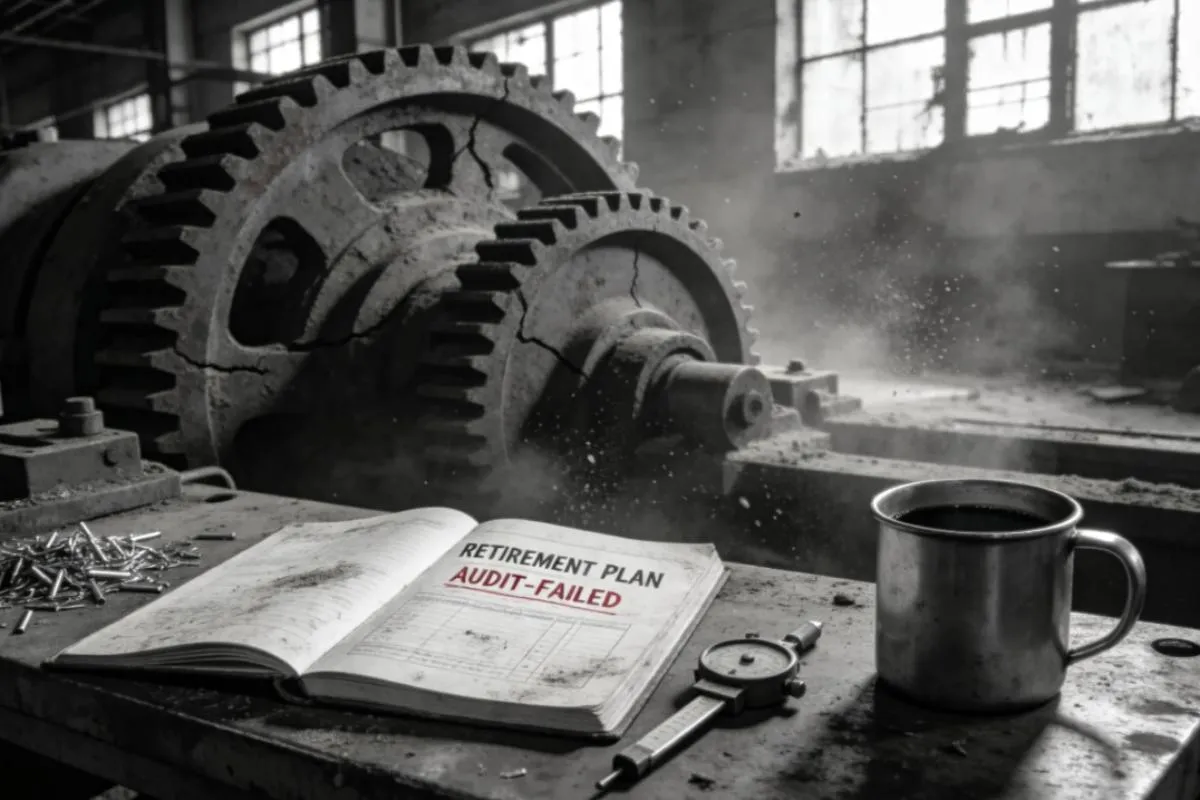
The Sound of a Broken Machine
I can tell when a factory is about to fail just by listening to it.
In 2014, I walked into a supplier’s facility in Stuttgart. The floor was clean. The managers were smiling. The coffee was hot. But there was a rhythmic clunk-hiss-clunk coming from the stamping press in the corner. It was a micro-second offbeat. To the untrained ear, it was just noise. To me, it was the sound of a bearing wearing out. It was the sound of a production line that was one week away from catastrophic failure.
I hear that same noise today when I look at the financial news.
A recent report says 70% of Millennials are terrified they will never retire. They think it is harder for them than it was for their parents. They are right. But panic is not a strategy. Panic is waste. Panic is friction.
I am a supply chain minimalist. In my world, we do not “hope” the parts arrive on time. We do not “wish” for quality. We build systems that make failure impossible.
Your life is a factory. Your income is the raw material. Retirement is not a vacation; it is your inventory management strategy for the time when you can no longer run the machine.
Right now, your factory is failing the audit. Let’s fix it.
The “70% Rule” is a Defective Part
Financial experts love to toss around “Rules of Thumb.” They are the lazy procurement managers of the financial world. The most dangerous one I see in the news today is the “70% Rule.”
They tell you: “To retire comfortably, you need to replace 70% of your working income.”
They say your costs will go down. They say you won’t need to drive to work or buy suits.
This is a lie.
In manufacturing, we have a term called “The Golden Sample.” This is the perfect unit the factory sends you to get the contract signed. It looks flawless. But when mass production starts, the quality drops, and the defects rise. The “70% Rule” is a Golden Sample.
The Reality of Rust (Inflation) Imagine you sign a contract to buy steel for ten years at a fixed price. Then, the price of iron ore doubles. The price of shipping triples. Your contract is now worthless.
That is inflation.
When you retire, you are not just sitting on a porch. You are fighting a war against “money rust.” Medical costs do not go down; they go up faster than anything else. Services become more expensive. If you aim for 70%, you are building a machine with no safety margin.
In German engineering, we over-engineer. We build bridges to hold ten times the weight of the trucks. Why? Because we hate risk. Do not aim for 70%. That is planning for poverty. Aim for 100% efficiency. If you end up with extra inventory (money), that is a “good problem.”
Protocol 1: Automation is the Only Discipline
I have fired many operators in my life. Not because they were bad people. But because they were human.
Humans get tired. Humans get distracted. Humans see a shiny new toy and forget to pull the lever.
The news report mentions a strategy: “Pay Yourself First.” It sounds nice, like a self-help poster. But let me translate this into industrial language: Full Automation.
When I set up a supply chain, I do not want the purchasing manager to decide to order more screws every Tuesday. Maybe he forgets. Maybe he is sick. I set up an automated trigger. When the bin gets low, the computer orders the screws. No human touches it.
The Audit Diary: The Munich Error
In 2009, I audited a firm that relied on manual checks for their safety valves. A guy named Hans walked around with a clipboard every Friday. One Friday, Hans left early for Oktoberfest. A valve leaked. The factory shut down for three weeks.
Cost of automation: $5,000. Cost of relying on Hans: $2.4 Million.
You are Hans. If you rely on your “willpower” to transfer money to your savings account at the end of the month, you will fail. You will see a sale. You will go out for dinner. You will find a reason to keep the cash.
You must remove yourself from the equation. Set up an automatic transfer on payday. The money leaves your account before you even see it. It is not your money anymore; it is raw material for your future self.
If you have to think about saving, you have already lost. The best process is the one you do not need to manage.
Protocol 2: Decoding the Warehouses (RRSP vs. TFSA)
People get confused by acronyms. The banks make it complicated so they can charge you fees to explain it. Let’s strip away the paint and look at the metal.
Think of these accounts as two different types of warehouses for your inventory (money).
1. The Bonded Warehouse (RRSP)
In international shipping, a “Bonded Warehouse” is a place where you can store goods without paying import duties (taxes) immediately. You only pay the tax when the goods leave the warehouse.
- The Logic: You put money in now, and you don’t pay tax on that income today. This lowers your tax bill right now.
- The Catch: When you take the money out in 30 years, you pay the tax then.
- Who is this for? This is for high-volume players. If you are making a lot of money today (high tax bracket), hide it in the Bonded Warehouse. Shield it from the tax man now.
2. The Free Trade Zone (TFSA)
This is the opposite. You pay your taxes on the money before you put it in the warehouse. But once it is inside, it is magic. It grows. It multiplies. And when you take it out? Zero tax. The government cannot touch it.
- The Logic: You pay the friction cost upfront to ensure zero friction later.
- The Flexibility: You can take stock out of this warehouse whenever you want without a penalty.
- Who is this for? Everyone. But especially if you think taxes will be higher in the future (they will be).
The Supply Chain Rule: If you are young (Millennial/Gen Z) and your income is lower, use the Free Trade Zone (TFSA). Why protect a small amount of money from a low tax rate? Pay the tax now, let it grow into a mountain, and keep the mountain tax-free.
If you are a high earner (Gen X/Boomer), use the Bonded Warehouse (RRSP) to lower your massive tax bill today.
Do not overthink it. Just fill the warehouses. An empty warehouse is a waste of floor space.
The Gen X Trap: The “Single Supplier” Risk
Gen X, I am talking to you now. You are the “Just-in-Time” generation. You are close to the deadline.
The data shows that many of you are relying on your home to fund your retirement. You think, “I will sell the house, downsize, and live on the cash.”
In my line of work, we call this Single Source Dependency. It is a fireable offense.
If you rely on one supplier for all your critical parts, and that supplier has a fire, you are out of business. If you rely on your house for your retirement, you are betting everything on the real estate market staying hot forever.
The Audit Diary: The Chrome Plating Disaster
We had a supplier who made the best chrome plating in Europe. We gave him 100% of our business. He bought a Ferrari. He stopped watching the tanks. The quality dipped. Then environmental regulations changed, and he was shut down overnight.
We had no backup. production stopped. We lost millions.
Your house is that chrome plater.
What if the market dips when you need to sell? What if you cannot find a cheaper place to live because all the smaller houses are expensive too?
A house is not just an asset; it is a liability. It leaks. It needs a new roof. It costs money to hold. Do not treat your home like a piggy bank. Treat it like a factory building. It is good to have, but it does not produce cash flow unless you sell it or rent it.
You need “Dual Sourcing.” You need liquid cash in the market and equity in your home. Diversify or die.
The Invisible Thief: “Lifestyle Creep”
There is a hidden cost in manufacturing called “scrap rate.” It is the material you throw away during production.
In your personal finance, this is called Lifestyle Creep.
You get a raise. Suddenly, the Honda is not good enough. You need the Audi. The drip coffee is not good enough. You need the espresso machine.
You are increasing your production costs every time your revenue goes up. This destroys your profit margin.
I live a simple life. I wear high-quality clothes, but I buy them once every five years. I drive a car that works. My “scrap rate” is near zero.
When you get a raise, that money should not change your life today. It should go directly to the “Automation Protocol” we discussed earlier. If you spend your raise, you are stealing from your future self to impress people you do not like.
Conclusion: Burn the Contract
The old social contract is dead. The company will not take care of you. The government pension is a safety net full of holes.
Stop looking for a savior. Stop looking for a “good year” in the market.
You must become the Director of your own supply chain.
- Audit your friction points: Where are you leaking money?
- Automate your raw materials: Auto-deposit savings on payday.
- Diversify your suppliers: Use both RRSP and TFSA. Don’t rely solely on your house.
- Reject the “Golden Sample”: Plan for a hard future, not a 70% efficient one.
This is not about being rich. It is about being operational. It is about making sure that when you are 75, the machine is still running, the lights are still on, and you are not begging for parts.
Class dismissed.
Victor S. The Supply Chain Minimalist