Microsoft’s $357 Billion Cannibal Act
The $357 Billion Tuition Fee
Let’s strip away the noise of the stock market ticker. Last week, Microsoft lost $357 billion in value in a single trading session. To put that number in perspective, that is roughly the entire GDP of Hong Kong vanishing into thin air between the closing bell and the next morning’s coffee.
Why? Because Wall Street looked at a spreadsheet and saw a “miss.” Azure—Microsoft’s cloud engine—grew slower than expected. The analysts panicked. They saw slowing growth coupled with record-breaking capital expenditures ($37.5 billion in one quarter). In their eyes, this is a disaster: spending more to earn less growth.
But they are looking at the wrong ledger.
I have sat in boardrooms during massive restructuring phases. I know the smell of “defensive allocation.” What happened with Microsoft wasn’t a blunder; it was a calculated sacrifice. The CFO, Amy Hood, admitted it openly if you speak the language of corporate finance. They didn’t miss Azure numbers because they lacked customers. They missed because they refused to serve them.
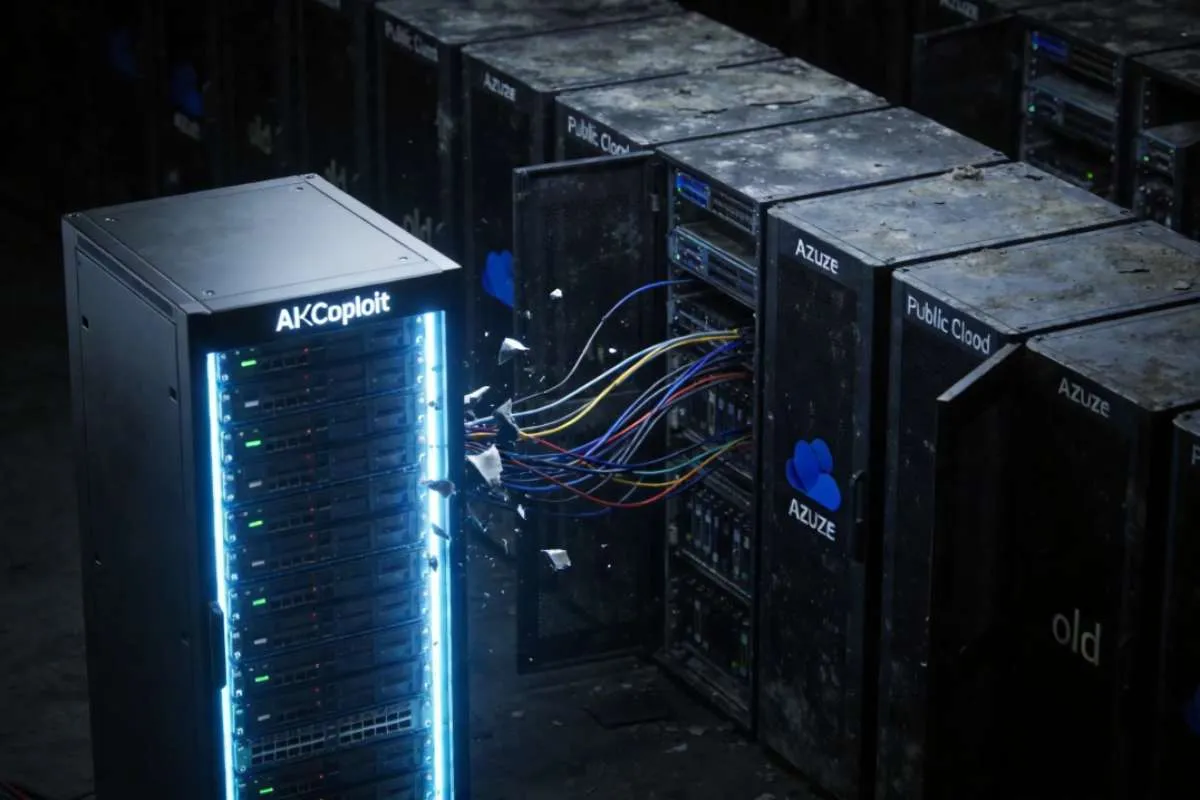
Microsoft hoarded its GPU capacity—the scarce lifeblood of the AI era—for itself. They starved their Azure rental business to feed their internal product teams (Copilot, GitHub).
This is not a cloud company stumbling. This is a software company realizing that if it doesn’t cannibalize its own inventory to build the next generation of products, it will cease to exist.
The IDM Trap: Eating Your Own Cooking
In the semiconductor industry, we used to have “Integrated Device Manufacturers” (IDMs) like Intel. They owned the factories (fabs) and they designed the chips. If you were an outsider wanting to manufacture a chip, you could technically rent space on their lines. But you always knew the truth: if push came to shove, Intel would prioritize its own chips over yours.
Then came TSMC. TSMC was a “pure-play foundry.” They didn’t design chips; they only manufactured them. They promised neutrality. They would never compete with their customers. This neutrality is why TSMC won the world.
For a decade, we treated the Cloud (Azure, AWS, Google Cloud) like a utility. We thought they were neutral power plants. But the AI shortage has exposed them as IDMs.
Consider the scenario: You are a massive enterprise paying Microsoft millions a year for Azure compute to run your custom AI models. Suddenly, GPUs become scarce. Microsoft has a choice:
- Rent those GPUs to you for a 30% margin.
- Use those GPUs to power GitHub Copilot, which drives sticky, long-term subscriptions and locks developers into the Microsoft ecosystem for the next decade.
Last quarter, Microsoft chose option 2. They effectively told Wall Street: “We could have hit your 40% growth target for Azure, but we chose not to.”
This is the “First Dibs” protocol. When the raw material of the economy (compute tokens) is scarce, the platform owner eats first. If you are building your AI future on top of a competitor’s cloud, you are now renting space in a landlord’s house who just realized he needs the spare room for his own children.
The Death of the “Per-Seat” License
The reason Microsoft is desperate enough to burn Azure revenue to fuel Copilot is simple: their Golden Goose is dying.
For thirty years, Microsoft’s business model has been the “Per-Seat” license. You hire an employee; you buy a seat of Office/Windows/M365. It is the greatest business model in history. It scales linearly with human population and employment.
But AI introduces a fatal decoupling.
I spoke recently with a logistics firm in Hamburg. They are looking to replace their level-1 dispatch team with AI agents. In the old world, that team was 50 people. That’s 50 licenses of Windows, 50 licenses of Office, 50 licenses of Teams.
In the new world, that might be 3 AI agents running on a server.
If Microsoft stays on the “per-seat” model, their revenue from that department drops by 94%.
This is why Satya Nadella is talking about “Work IQ” and agents. They are scrambling to shift the monetization model. They need to transition from selling “tools for humans” to selling “digital workers.”
If they can sell you an “Accounting Agent” for $5,000 a month that replaces a junior accountant who cost you $60,000 a year, they capture value. But to do that, the agent must be exceptional. It must be integrated into every file, every email, and every security protocol.
That requires massive compute. That requires the GPUs they refused to rent to Azure customers.
The market sees a “miss” in cloud revenue. I see a company frantically burning furniture to build a lifeboat before the “per-seat” ship sinks.
The Software Supply Chain Paradox
There is a buzzword floating around: “The end of software.” The theory goes that if AI can write code, software becomes a commodity. Why pay Salesforce when you can ask an AI to build you a CRM?
I disagree. In my experience, “cheap production” rarely leads to “do it yourself” for large enterprises.
When fabric became cheap during the Industrial Revolution, we didn’t start weaving our own clothes at home. We bought more clothes, and we demanded better designs.
However, the margin structure of software is about to change violently.
For the last ten years, the Silicon Valley playbook was:
- Find a niche (e.g., “Expense Management for Dentists”).
- Hire cheap developers to build a SaaS app.
- Spend massive amounts on sales to acquire customers.
- Enjoy 80% gross margins because the code costs nothing to replicate.
AI changes the input costs. “Writing the code” is now becoming free. But “running the code” is becoming expensive.
If your software relies on heavy AI inference (tokens), your margins are no longer just server electricity. You are paying a “token tax” to the model providers (OpenAI, Anthropic, Google).
This creates a new class of winner: The Arms Dealer.
If Microsoft integrates AI into VS Code and GitHub, they are not just selling a tool; they are selling the factory floor. They become the primary input for every other software company.
By prioritizing GitHub Copilot over general Azure capacity, Microsoft is trying to ensure that all future software is manufactured on their machines. They don’t mind if the price of software falls, as long as they own the foundry where it is forged.
The Neutrality Void: A New Market Opening?
Here is the strategic vulnerability that Microsoft has just exposed. By proving they will prioritize themselves, they have frightened the market.
If I am the CIO of a large bank or a rival tech firm, I am looking at this quarter and sweating. I cannot rely on a supplier who competes with me for the same scarce resource.
This opens a massive door for a “Swiss Bank” of compute.
We are seeing the rise of “Neo-clouds”—companies like CoreWeave—and the resurgence of Oracle. Why? Because they are acting like TSMC. They are saying: “We don’t have a Search engine. We don’t have a productivity suite. We don’t have a Copilot. We just sell tokens. We will never prioritize ourselves over you.”
I expect to see a significant capital flight away from the Hyperscalers (AWS/Azure/Google) toward these neutral token foundries for mission-critical AI workloads. The risk of being “throttled” by your competitor is now non-zero. In risk management, non-zero is unacceptable.
The “Vibe Coding” Mirage
Let’s address the engineering reality. There is chatter about “vibe coding”—the idea that non-technical people will just “vibe” with an AI to build massive systems.
This is dangerous optimism.
I have managed engineering teams. The difficult part of software is not typing the syntax. The difficult part is architecture, security, state management, and compliance.
AI is fantastic at generating blocks of logic. It is currently terrible at maintaining systems of logic.
However, the efficiency gains are real. I recently reviewed a project where a team delivered a feature in three days that was scoped for two weeks. They used AI to handle the boilerplate.
What does this mean for the business? It means the “mediocre middle” of software engineers is in trouble. But it also means the “mediocre middle” of software companies is dead.
If you are a SaaS company whose only value proposition is “we have a basic database with a nice UI,” you are finished. A client can now build that internally with an AI agent in a weekend.
The only surviving software companies will be those that offer:
- Proprietary Data: You have data the AI cannot access elsewhere.
- Regulatory Moats: You handle compliance that is too risky to automate.
- Complex Integration: You connect 50 messy systems that an AI would hallucinate trying to fix.
Microsoft knows this. That is why they are doubling down on “Work IQ.” They want to own the context of your work (your emails, your chats, your files). An AI can write code, but it cannot know that “Project Alpha” is confidential and “Project Beta” is public unless it has deep integration into your enterprise identity.
The Bottom Line
Wall Street punished Microsoft for slowing down today. They should be terrified of what Microsoft is building for tomorrow.
The $37.5 billion CapEx spend is not a gamble on a bubble. It is the cost of re-platforming the entire global economy.
- The “Miss” was intentional. Microsoft is starved for chips, so it fed its own children first. This validates the “IDM” risk for Azure customers.
- The Model Shift. They are racing to move from “Per-Seat” (which dies with AI) to “Per-Outcome” (Agents).
- The New Moat. It isn’t the software; it’s the context. By owning the identity layer (Active Directory + Graph), Microsoft aims to be the only agent provider that actually knows who you are.
Do not look at the stock drop and see weakness. Look at the allocation of resources and see ruthlessness. Microsoft is preparing for a war where software is cheap, but intelligence is expensive. And they intend to own the generator.