The Gold Flash Crash and the 38 Trillion Dollar Reality
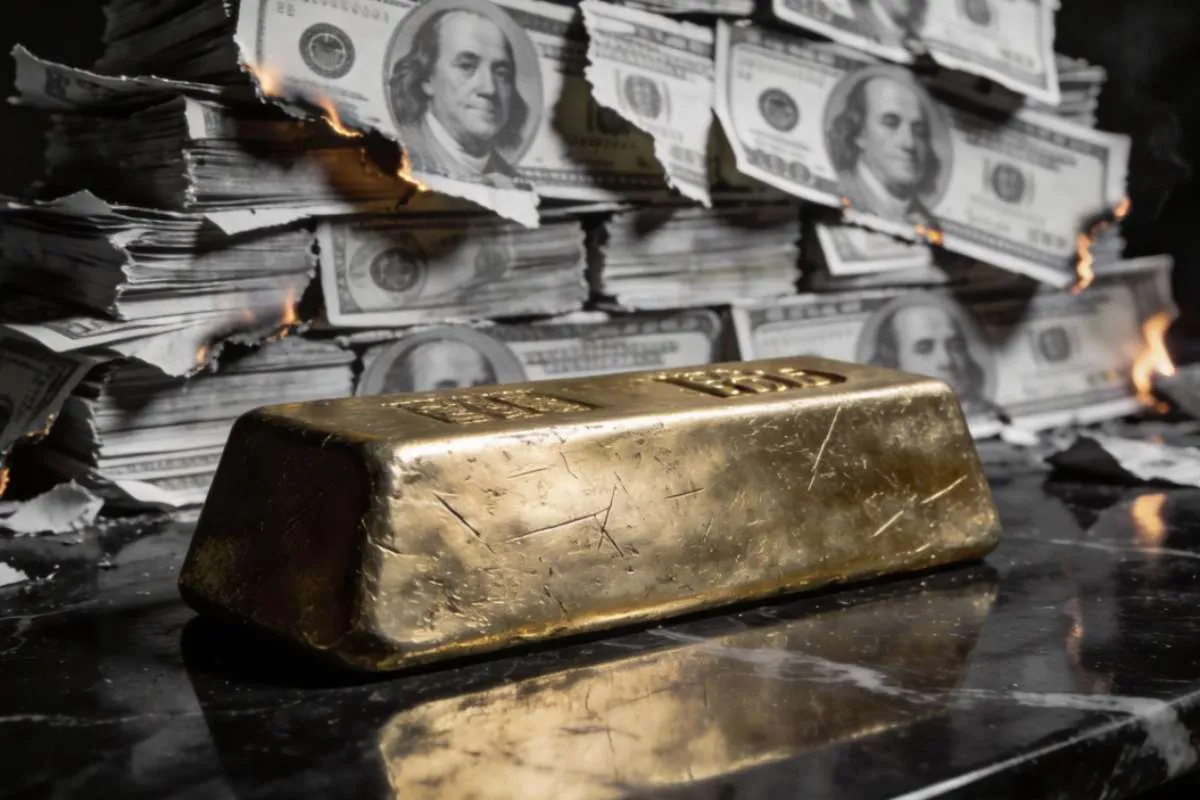
The Mechanics of a Parabolic Breakdown
When I look at a chart that goes vertical, I do not see success. I see fragility. In the business of asset management, we have a saying: stairs up, elevator down. This is exactly what we witnessed this past Friday and Monday.
Gold touched a record peak of almost $5,595 an ounce. Silver, always the more dramatic sibling, hit nearly $122. These are numbers that would have seemed absurd five years ago. But when an asset class doubles or quadruples in a short window, the air becomes thin.
The drop was violent. Gold plunged about 10 percent, and silver crashed 28 percent. To the uninitiated, this looks like the end of the bull market. To a strategist, this is a standard liquidity flush. When prices go “parabolic,” as Mark Matthews from Bank Julius Baer correctly noted, the buying is no longer driven by logic but by Fear of Missing Out (FOMO).
The mechanism here is simple. Professional traders—the ones I used to work alongside—do not wait for the trend to turn. They have profit targets. When gold hit that $5,595 mark, algorithms and institutional desks hit “sell” simultaneously. The snowball effect kicks in. The decline was not necessarily because the fundamental value of gold changed overnight. It happened because there were simply no buyers left at the top.
The Trump Factor and the Illusion of Stability
The media is desperate to pin this volatility on a single person. They point to Donald Trump. It is true that his return to the White House has introduced a level of chaos that markets generally despise. From threats to take over Greenland to aggressive tariff policies, he has taken a sledgehammer to diplomatic and economic orthodoxy.
However, we must look at the specific trigger for the sell-off. Trump announced the nomination of Kevin Warsh to lead the Federal Reserve. Warsh is an insider. He is a former member of the Fed’s board of governors. In the eyes of the market, he represents “adult supervision” in a room full of wild theories.
The market dumped precious metals because Warsh signals a return to conventional monetary policy. Investors, who had been buying gold as insurance against a Trump-appointed loyalist who might slash interest rates recklessly, felt they could take their insurance off the table.
But let us be clear: this is a temporary optical illusion. The appointment of a conventional central banker does not solve the underlying insolvency of the system. It merely puts a polite face on a disaster.
The 38 Trillion Dollar Elephant in the Room
We need to stop talking about personalities and start talking about the balance sheet. The United States national debt has grown to $38 trillion. This is the highest absolute debt figure in the history of the world.
In my years managing corporate operations, if a division ran a balance sheet like the US government, we would have liquidated it and sold the furniture. But a government cannot be liquidated; it can only default.
There are two ways a government defaults. The first is an “hard default,” where they simply stop paying interest. The US will likely never do this. The second is a “soft default,” where they print enough money to pay the debt, but the money they pay you back with is worth significantly less than when you lent it.
This is the “crisis of confidence” analysts are whispering about. Gold rising to $5,595 is not actually gold becoming more expensive. It is the dollar becoming worthless. The math is inescapable. With Japan and Italy also drowning in debt, the entire fiat currency system is under pressure.
When you hold dollars, you are holding a share in that $38 trillion debt. When you hold gold, you hold the only financial asset that is not someone else’s liability.
Understanding Counterparty Risk
Diego Franzin of Plenisfer Investments put it perfectly: “Gold remains the only asset without a counterparty.”
Let me explain what this means in practical business terms.
If I sign a contract with a supplier, my risk is that the supplier goes bankrupt. That is counterparty risk. If I buy a US Treasury bond, my risk is that the US government changes the rules or inflates the currency. That is counterparty risk. If I put money in a bank, I am technically lending money to that bank. If the bank fails, I have a problem. That is counterparty risk.
Gold makes no promises. It pays no interest. It does not depend on a vote in Congress or a decision by the European Central Bank. It simply exists. In a world where every financial interaction is based on credit—which is really just a fancy word for debt—an asset that exists outside that system commands a premium.
This is why the volatility we saw this week is noise. The fundamental reason to own gold—to escape the credit risk of insolvent governments—has not changed because Kevin Warsh was nominated.
The Geopolitical Pivot: Smart Money is Moving
While retail investors in the West were panic-selling on Monday, look at who has been buying over the last year.
Central banks in emerging economies, specifically China and Turkey, have been aggressive buyers. Why? They are not trying to make a quick 10 percent profit. They are engaging in a strategic geopolitical pivot.
These nations are actively trying to lessen their dependence on the US dollar. They have seen how the US uses the dollar as a weapon in sanctions. If you are a foreign leader, you realize that holding your national reserves in US dollars means the US government can freeze your savings at any moment.
Moving reserves into gold is a defensive capability. It is a declaration of financial sovereignty. This is a structural trend that will last for a decade, not a week. The “smart money” here represents sovereign states protecting their existence, not day traders looking for a quick flip.
The Outlook: Volatility vs. Trend
So, where do we go from here?
The drop was severe. Gold ended Monday down 4.5 percent and silver down 6.5 percent. But by Tuesday, we already saw a recovery, with gold clawing back 3.5 percent.
JP Morgan analysts are projecting gold to reach $6,300 an ounce by the end of 2026. This would be a 30 percent gain from current levels.
Is this realistic? In my view, yes. The fundamental drivers—the “engine” of this move—are still intact.
- Dollar Depreciation: The US dollar must weaken structurally to make the debt manageable.
- Central Bank Demand: Nations will continue to diversify away from the dollar.
- Inflationary Pressure: You cannot print your way out of debt without causing inflation.
Conclusion: The Business Case for Patience
In business, we differentiate between “operational noise” and “strategic shifts.”
The price drop this week was operational noise. It was leverage being flushed out of the system. It was traders booking bonuses.
The strategic shift is the erosion of faith in the fiat currency system. That has not changed.
The price ascent will likely be slower now. As Mark Matthews noted, the slope won’t be as steep, and “that’s a good thing.” A sustainable rise is better than a rocket ship that explodes.
Do not get distracted by the daily ticker tape. The $38 trillion debt is still there. The political instability is still there. The value of holding an asset that nobody can print is still there.
The market has simply gone on sale. Smart operators do not panic when prices drop; they assess the value and act accordingly.