The Inevitable Decline of Gasoline
A surface-level glance at the American economy reveals a contradiction. Vehicle miles driven have reached a new record. More goods are being moved, more commutes are being made, and more activity is taking place on our roads than ever before. The conventional logic, which has held true for a century, dictates that this should correlate with a surge in gasoline consumption. Yet, the opposite is happening.
U.S. gasoline consumption is falling. Not just in a temporary, recession-induced dip, but in what is now clearly a long-term, structural decline. In 2025, consumption fell to levels last seen in 2003, despite the addition of over 50 million people to the population. Per capita, gasoline use has plummeted to its lowest point since 1967, excluding the anomaly of 2020.
This is not a statistical fluke. It is the decoupling of economic activity from fuel consumption. This is the signal that the foundational business model for the downstream oil and gas industry in the developed world is breaking. To understand the strategic implications, one must ignore the noise of daily price fluctuations and dissect the two powerful, relentless forces driving this change: the compounding effect of vehicle efficiency and the exponential disruption of electrification.
The Silent Compounding of Efficiency
The most significant driver of gasoline’s decline is also the least dramatic. It isn’t the headline-grabbing electric vehicle; it’s the slow, methodical, and irreversible improvement in the fuel economy of the internal combustion engine (ICE) fleet. For decades, a combination of regulatory pressure and engineering innovation has been a quiet headwind against demand. The data is unequivocal: the average fuel economy of passenger vehicles sold in the U.S. has risen by 43% over the past 25 years.
This is not a linear effect; it is a compounding one. Each year, the oldest, least efficient vehicles are scrapped and removed from the fleet. They are replaced by newer models that, on average, travel significantly farther on a gallon of gasoline. This process acts as a one-way ratchet on aggregate demand. The fleet’s overall efficiency never goes backward. Every new car sold chips away at the nation’s total fuel requirement, even if it is still a gasoline-powered vehicle.
From a business strategy perspective, this is a slow-motion crisis for refiners and fuel retailers. An annual 2% improvement in fleet-wide fuel efficiency is equivalent to a permanent 2% reduction in the size of your addressable market, assuming miles driven remain constant. It forces companies to compete with increasing ferocity for a share of a slowly but surely shrinking pie. The capital allocation decisions made a decade ago to expand refining capacity or build new retail locations were predicated on a stable or growing demand base. That assumption is now invalid.
This trend was set in motion by the oil shocks of the 1970s, which permanently embedded the concept of fuel economy into consumer psychology and federal regulation. The result is a multi-decade technological trajectory that is now reaching a critical stage. The low-hanging fruit of efficiency has been picked, but the engineering gains continue, creating a persistent downward pressure that the industry can no longer offset with simple population growth.
The EV Disruption Multiplier
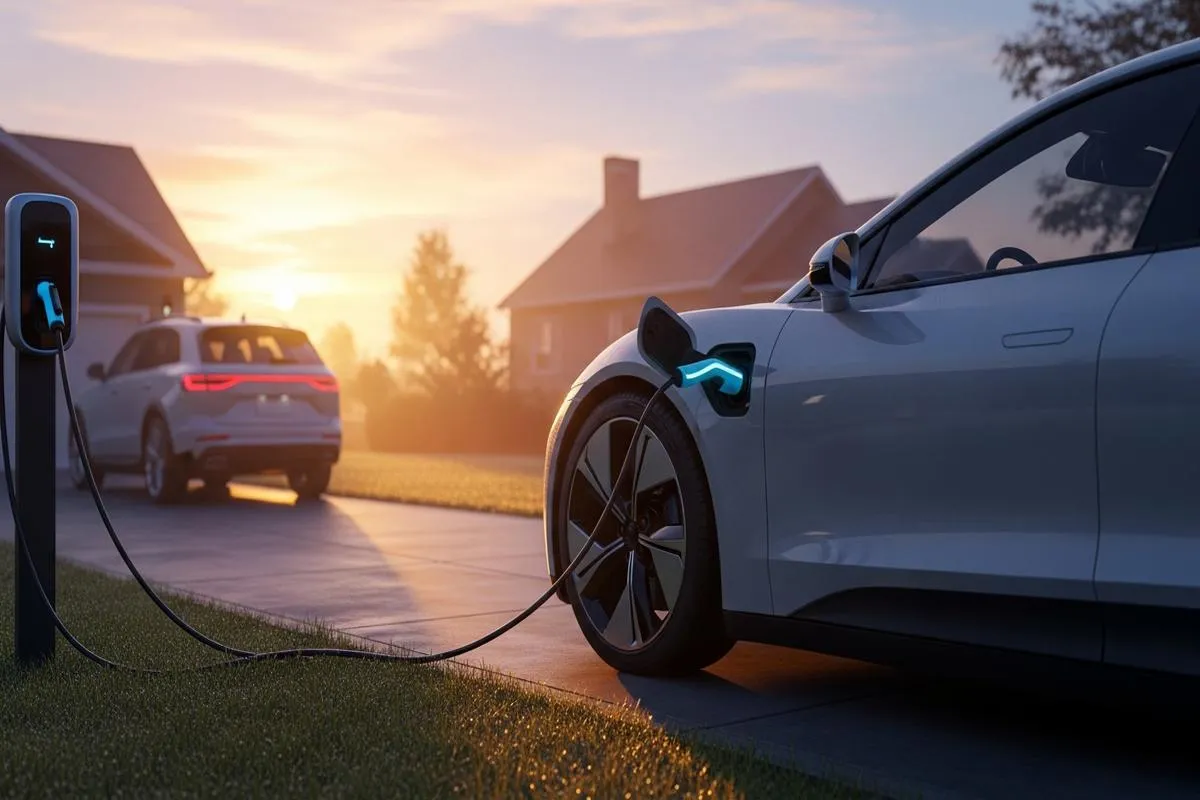
If ICE efficiency is a slow-acting poison, the electric vehicle is a dagger. While a more efficient gasoline car reduces demand, an EV eliminates it entirely for that vehicle’s owner. It does not substitute a different brand of gasoline; it removes the customer from the market permanently. This is the difference between erosion and disruption.
The adoption of EVs is following the classic S-curve model seen in every major technological shift. We are currently moving past the early adopter phase and into the steep part of the curve—the early majority. This means the rate of demand destruction is set to accelerate significantly. A 10% market share for EVs does not mean a 10% reduction in gasoline demand. It means a 10% reduction concentrated among the newest, highest-mileage drivers, who are often the most profitable customers for the fuel industry.
This shift has profound second-order effects on the entire value chain. The business model of the modern gas station, for example, is not built on selling gasoline. Fuel is a low-margin commodity used to draw customers into the high-margin convenience store. The profit is in coffee, snacks, and lottery tickets. When the primary reason for the visit—refueling—is removed, the entire model is threatened.
Similarly, the automotive repair industry faces a structural challenge. EVs have drastically fewer moving parts, no oil to change, and no exhaust systems to fail. This reduces the total lifetime service revenue a vehicle can generate, impacting a vast network of independent mechanics and dealership service centers. The entire ecosystem built around the internal combustion engine is being hollowed out from the inside.
The Refinery’s Dilemma: Export as a Stopgap
Faced with a structurally declining domestic market, U.S. refiners have pivoted. The data shows a massive surge in exports of refined products, including gasoline. On the surface, this appears to be a successful adaptation. The U.S. has transformed into a net exporter of petroleum products, leveraging its advanced refining capabilities and access to abundant domestic crude oil.
However, this strategic pivot is not a long-term solution. It is a form of geographic and temporal arbitrage—a stopgap measure. U.S. refiners are exporting their products to markets, primarily in Latin America, that have less stringent emissions regulations, older vehicle fleets, and lower EV penetration rates. They are, in effect, selling to the past.
This strategy trades one set of problems for another. By shifting their focus from a predictable, albeit declining, domestic market to the international stage, refiners expose themselves to a host of new risks:
- Volatility: Global markets are subject to geopolitical instability, currency fluctuations, and the economic health of developing nations. A recession in Mexico or Brazil has a direct impact on the profitability of a Gulf Coast refinery.
- Competition: U.S. refiners now compete directly with massive, state-of-the-art refineries being built in the Middle East and Asia, which are often closer to the remaining growth markets for fuel demand.
- Transitory Demand: The very forces eroding U.S. demand—efficiency and electrification—are global trends. While other markets are years behind the U.S., they are on the same trajectory. The export window is not infinite.
This pivot favors only the largest and most operationally efficient players. The complexity of managing global supply chains, hedging currency risk, and navigating international trade law creates enormous barriers to entry. The likely outcome is further consolidation in the U.S. refining sector, as smaller, less sophisticated operators find themselves unable to compete in either the shrinking domestic market or the complex global one.
The Unforgiving Logic of Per-Capita Decline
Ultimately, the most telling metric is the simplest: gallons consumed per person. This figure cuts through the noise of population growth and fluctuating economic activity. It reveals the core relationship between the individual and the product. And that relationship is fundamentally weakening.
The decline in per-capita consumption to levels not seen in over half a century is the clearest possible signal of long-term demand destruction. It tells us that the average American’s need for gasoline is structurally and permanently decreasing.
This has profound implications for capital allocation. Any investment in gasoline-centric infrastructure—be it a new refinery unit, a pipeline, or a retail station—is now an investment into a declining asset class. The terminal value of these assets in any discounted cash flow analysis is trending toward zero. The question for investors and executives is no longer about growth, but about managing a controlled decline. How can you extract the maximum value from existing assets before they become obsolete?
This is a brutal strategic reality. It requires a shift in mindset from expansion to optimization, from market capture to cash harvesting. It means shuttering less-efficient facilities, divesting from low-performing retail sites, and resisting the urge to pour capital into projects with a 30-year lifespan in a market whose foundations are eroding annually.
Conclusion: Managing the End Game
The story of U.S. gasoline demand is no longer one of cyclical peaks and troughs. It is a story of a structural break with the past. The combined, relentless pressures of ICE efficiency and EV adoption have created a permanent headwind that cannot be overcome. The link between economic growth and fuel consumption is severed.
Refiners’ pivot to exports is a logical but temporary response, trading a managed domestic decline for a more volatile international game. The fundamental challenge remains. The transition away from gasoline will be slow, uneven, and fraught with political and economic friction. But the underlying mechanics are undeniable. The value is migrating away from the pump and toward the plug, the battery, and the grid.
For strategists, investors, and policymakers, the path forward requires acknowledging this reality. The era of gasoline’s dominance in transportation is ending. The winning strategies will not be found in attempts to revive a dying market, but in disciplined management of its decline and aggressive reallocation of capital toward the energy systems of the future. The value has moved. Following it is the only rational course of action.