The AI Boom Is Pouring Concrete
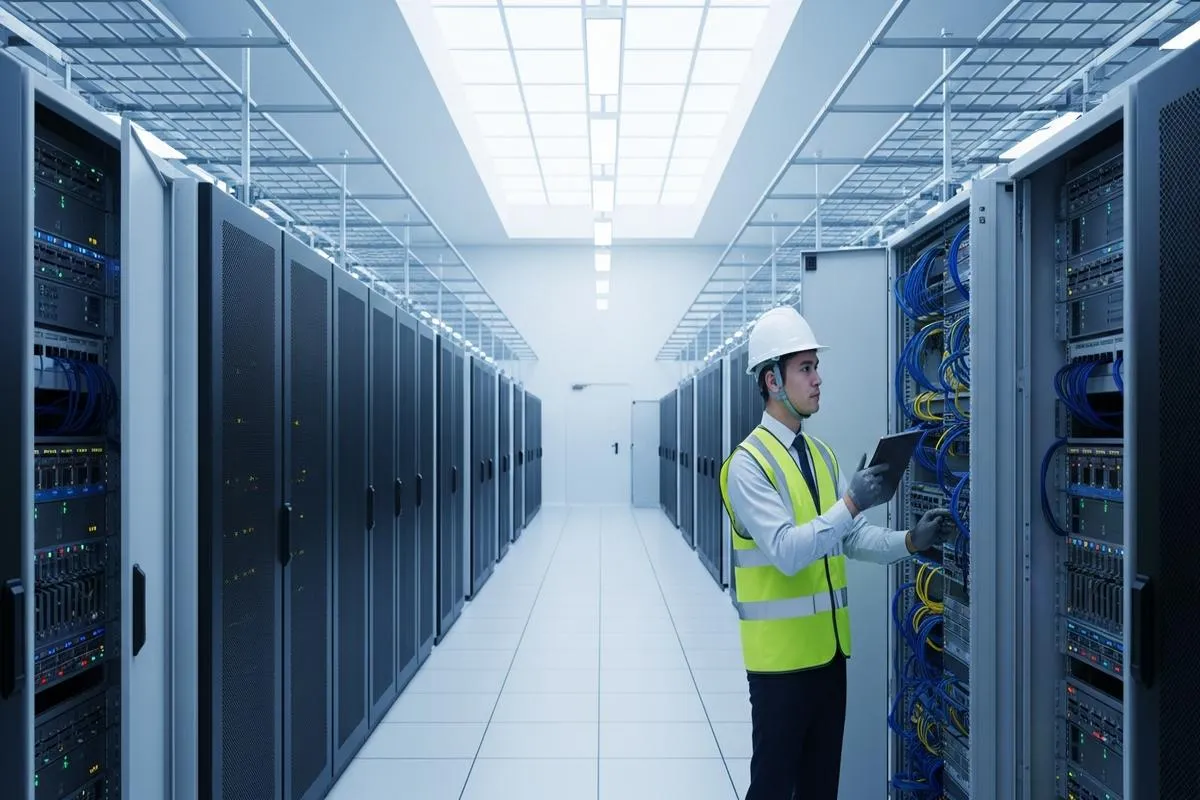
The market has a brutal, simple clarity. For the first time, annual construction spending on data centers has surpassed spending on office buildings. This is not a cyclical dip or a minor trend reversal. It is a fundamental reallocation of capital, a verdict on where future value lies. The era of building glass towers to house knowledge workers is over. The era of building fortified warehouses for silicon has begun.
While the financial press obsesses over corporate headcount and return-to-office mandates, the smart money is following the compute. The office sector is not just in a slump; it is facing a structural crisis of demand, rendering billions in assets obsolete. The decline is sharp and rational. The boom, however, is explosive and deserves closer inspection.
The Unprecedented Demand for Compute Infrastructure
Data center construction spending has soared to an annual rate of $47 billion, a five-fold increase since the start of 2021. This figure, while staggering, represents only the cost of the physical shell. It does not account for the astronomical sums spent on the specialized servers, networking gear, and cooling systems housed within—the actual value-generating assets.
This firehose of capital is a direct consequence of the AI arms race. A handful of technology giants have publicly committed nearly $700 billion in capital expenditures, with the explicit goal of building out AI infrastructure.
- Amazon: $200 billion
- Alphabet: $175-185 billion
- Meta: $135 billion
- Microsoft: $145-150 billion
- Oracle: $42 billion
This is not speculative investment. It is a calculated necessity to secure a stake in the next generation of technology. The market is rewarding proximity to computational power, and these firms are building the new prime real estate.
The Physical Limits of a Digital Boom
An exponential growth curve always collides with physical reality. The data center construction boom is already hitting predictable, and costly, bottlenecks. The constraints are not in finance, but in the tangible world.
First is the shortage of specialized labor, particularly electricians capable of handling high-voltage industrial installations. Second is the supply chain for critical electrical equipment—transformers, switchgear, and backup generators. These are not off-the-shelf components, and manufacturing capacity was never designed for this level of demand shock.
The ultimate constraint, however, is power. A single large data center can consume as much electricity as a small city. The grid in its current state cannot support this concentrated demand. This leads directly to the next critical investment wave.
The Second-Order Effect: Powering the Machine
Following the logic of demand, construction spending on power generation and transmission has climbed to an annual rate of $122 billion. Data centers are not just buildings; they are immense drains on energy resources that require their own dedicated infrastructure.
This presents a dilemma for utility providers. They are being asked to fund multi-billion dollar, long-term infrastructure projects—power plants and transmission lines—to service an industry known for its rapid, and sometimes brutal, cycles. The core risk is that of stranded assets. What happens if the AI bubble deflates after the utility has spent a decade and billions of dollars building a power plant in a remote location to service a now-defunct data center? This forces a level of prudence and risk assessment that will inevitably throttle the pace of growth.
The Reshaping of American Manufacturing
Beyond data centers, a quieter but equally significant boom has been reshaping the factory landscape. Total factory construction spending, while down from its recent peak, remains at a historically high $195 billion annual rate—over four times the spend on data centers.
This wave was initially driven by strategic, government-subsidized sectors like semiconductor and battery plants. While that initial surge is now moderating, the underlying trend remains. New factories are being built, but they are not the factories of the 20th century.
The cost structure of US labor prohibits the construction of low-skill assembly plants. Any new facility must be predicated on a high degree of automation. The key insight is that automated production equipment—robotics, CNC machines—costs roughly the same anywhere in the world. It is the great equalizer that neutralizes high domestic labor costs. We are not re-shoring jobs; we are re-shoring capital-intensive, automated production.
A Permanent Shift in Capital Allocation
The divergence between office and data center construction is more than a chart. It is a clear signal of a permanent shift in the economy’s physical footprint. We are moving from building environments for people to building environments for machines.
Value is no longer measured in corner offices and downtown prestige, but in megawatts per square foot and network latency. The concrete being poured today is for a future where the most valuable work is done not by humans at desks, but by processors in racks. This is not a trend to watch; it is a reality to price in.