The Accidental Landlord is a Trap
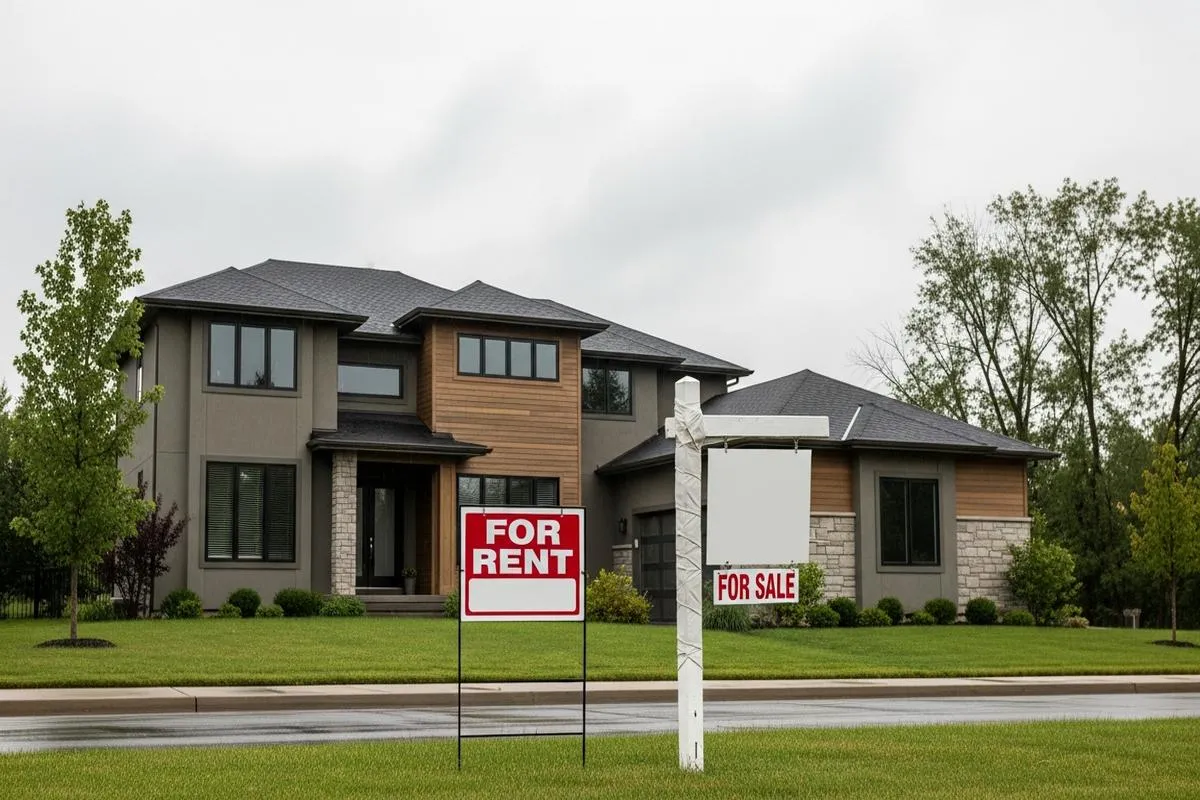
The prevailing narrative is that an increase in housing supply, any supply, is the antidote to an affordability crisis. Commentators point to the rising number of vacant units and see a market heroically correcting itself. They see homeowners who couldn’t sell pivoting to become landlords and call it a flexible response to market conditions. This is a dangerously superficial reading of the situation.
That pivot is not a strategy; it’s a distress signal. The emergence of the “accidental landlord” is not a sign of market health, but a symptom of a widespread capital trap. We are witnessing the birth of a new class of involuntary, undercapitalized, and fundamentally unprofitable small business owners. The story isn’t about supply. It’s about the catastrophic unit economics these individuals are about to discover.
The Overlooked Angle
Forget the macro charts of total housing units versus population growth. That’s a 30,000-foot view that misses the friction on the ground. The most critical, and most overlooked, variable in today’s housing market is the collapsing business model of the accidental landlord.
We must stop analyzing these participants as a housing statistic and start analyzing them as what they are: forced entrants into a low-margin, high-overhead business they are entirely unprepared for. Their financial fragility is the true shadow inventory. Their eventual capitulation, not new construction, will dictate the price floor for both rental and for-sale markets in the coming cycle. The story is not in the number of units shifting from one column to another, but in the negative cash flow accumulating within each of those units.
Why This Small Detail Matters
One accidental landlord is a personal financial problem. A million of them is a systemic risk. The financial health of an asset owner determines the nature of the supply they provide. Supply from a well-capitalized Real Estate Investment Trust (REIT) is patient. It can absorb vacancies and ride out market downturns. It operates on a long time horizon, optimized for yield and appreciation over a decade.
Supply from an accidental landlord is brittle. It is owned by an individual whose primary mortgage was predicated on it being a primary residence, not a business asset. This owner is often covering a monthly cash flow deficit from their active income. They have a short time horizon, driven by the hope of breaking even on a sale “next year.”
This creates an enormous overhang of unstable inventory. These are not strategic holdings; they are liabilities masquerading as assets. When a critical mass of these owners can no longer sustain the monthly losses, or when their personal financial situation changes—a job loss, a medical emergency—they will be forced to sell. They will not sell at their original “wishful price.” They will sell at whatever price the market will bear to stop the bleeding. This is how a slow market correction becomes a rapid, cascading price decline.
The Economic Mechanism
To understand the trap, one must dissect the brutal economics of being an accidental landlord in a high-interest, peak-price market. The model is fundamentally broken from the start.
The Negative Carry Predicament
The core problem is negative carry. For most who bought or refinanced in recent years, the monthly payment for Principal, Interest, Taxes, and Insurance (PITI) is significantly higher than the market rent they can achieve. Let’s assume a homeowner bought a $500,000 house with a 20% down payment, securing a $400,000 mortgage at 6.5%. Their principal and interest alone are roughly $2,500. Add another $800 for property taxes and insurance, and their monthly holding cost is $3,300.
The market rent for that same property might be $2,800. Right out of the gate, they are losing $500 per month. This isn’t a business; it’s a subsidized tenancy. The owner is paying for the privilege of letting someone else live in their illiquid asset, all while hoping the asset’s value magically recovers to their purchase price.
The Unseen Cost Stack
That $500 monthly loss is just the beginning. The amateur owner consistently fails to underwrite the operational drag and capital expenditures required to run a rental property. The true cost stack is far larger:
-
Vacancy Costs: The industry standard is to budget for 5-10% vacancy. For a $2,800/month rental, that’s an annualized cost of $1,680 to $3,360. A single month of vacancy wipes out any thin margin that might have existed.
-
Tenant Turnover: Between tenants, the property needs work. This includes deep cleaning, carpet replacement, patching and painting walls, and marketing the property. These costs can easily run into the thousands of dollars every couple of years.
-
Property Management: If they hire a professional, it’s typically 8-10% of gross monthly rent. That’s another $220-$280 per month straight off the top. If they manage it themselves, they are incurring a significant time cost and exposing themselves to risks they don’t understand.
-
Maintenance & Repairs: Things break. Faucets leak, appliances fail, and HVAC systems die. A conservative budget is 1% of the property’s value per year. For a $500,000 home, that’s $5,000 annually, or over $400 per month that must be set aside.
-
Capital Expenditures (CapEx): These are the big-ticket items that have a finite lifespan: the roof, the water heater, the windows. These are not ‘if’ costs; they are ‘when’ costs. An accidental landlord, already running a monthly deficit, almost never has a dedicated CapEx reserve.
When you add these realistic operational costs to the initial negative carry, the true monthly loss is not $500, but likely well over $1,000. This is an unsustainable financial drain.
The Capital Friction Problem
The final nail in the coffin is the complete loss of liquidity. The owner’s equity is trapped. They cannot sell without realizing a significant loss. They cannot borrow against the equity because lenders are wary of the asset’s performance. This capital is frozen, unable to be deployed to higher-return investments or used to handle a personal financial emergency. The opportunity cost is immense. The asset has become a ball and chain.
The Strategic Consequence
This dynamic reshapes the market and creates clear winners and losers.
The Losers:
- Accidental Landlords: They are the primary victims, caught in a cash-burning trap with no easy exit. Their financial pain will only grow over time.
- Traditional Small Landlords: They now face irrational competition. Accidental landlords, desperate for a tenant to offset some of their losses, will often undercut market rents, putting downward pressure on yields for everyone.
- Homeowners in the Same Market: The eventual, inevitable sale of these properties at a loss will re-price comparable homes in the neighborhood, pulling down values for all homeowners.
The Winners:
- Renters (Short-Term): In the immediate term, this influx of desperate rental supply can lead to flat or falling rents and more concessions from landlords.
- Property Management Companies: They gain a new client base of overwhelmed owners who need to outsource the operational headache.
- Institutional Investors: Well-capitalized funds with no debt or low-leverage debt are the real beneficiaries. They can wait patiently for the accidental landlords to reach their financial breaking point and then acquire these properties at a significant discount to both replacement cost and prior market peaks.
What Most Commentary Gets Wrong
The lazy analysis is that this shift from ‘for-sale’ to ‘for-rent’ is simply supply finding its level. This assumes all supply is created equal. It’s not. It’s the difference between a warehouse full of steel beams and a warehouse full of dynamite.
Brittle supply held by over-leveraged, financially stressed owners is inherently unstable. It doesn’t act like traditional inventory. It doesn’t respond to gentle price signals. It holds on, accumulating losses, until it breaks. When it breaks, it floods the market not as a trickle but as a torrent of distressed sales. Pundits cheering for “more supply” are failing to differentiate between healthy, sustainable inventory and a backlog of future forced liquidations. They are mistaking a symptom of market dysfunction for a cure.
The Hard Business Lesson
Hope is not a viable business strategy. Delaying a loss does not eliminate it; it often compounds it. Converting an unsellable, overvalued asset into an unprofitable rental operation is not a strategic pivot. It is an act of financial procrastination.
The rise of the accidental landlord is the clearest evidence of widespread denial in the housing market. It’s a refusal to accept that price discovery is necessary. But markets are unsentimental. The carrying costs are real, and the monthly bank drafts are relentless. The true market clearing will not come from new construction. It will come when the pain of holding on exceeds the pain of selling at a loss. That day is coming for millions of accidental business owners, and it will define the next chapter of the housing story.